Nurturing a Sense of the Strange
Reflections on The Strange Archive
The Strange Archive was on view from 17 January - 1 February 2026 at Tanjong Pagar Distripark (Block 37, 04-01D), Singapore. The show was part of Singapore Art Week and is supported by the National Arts Council, Singapore.
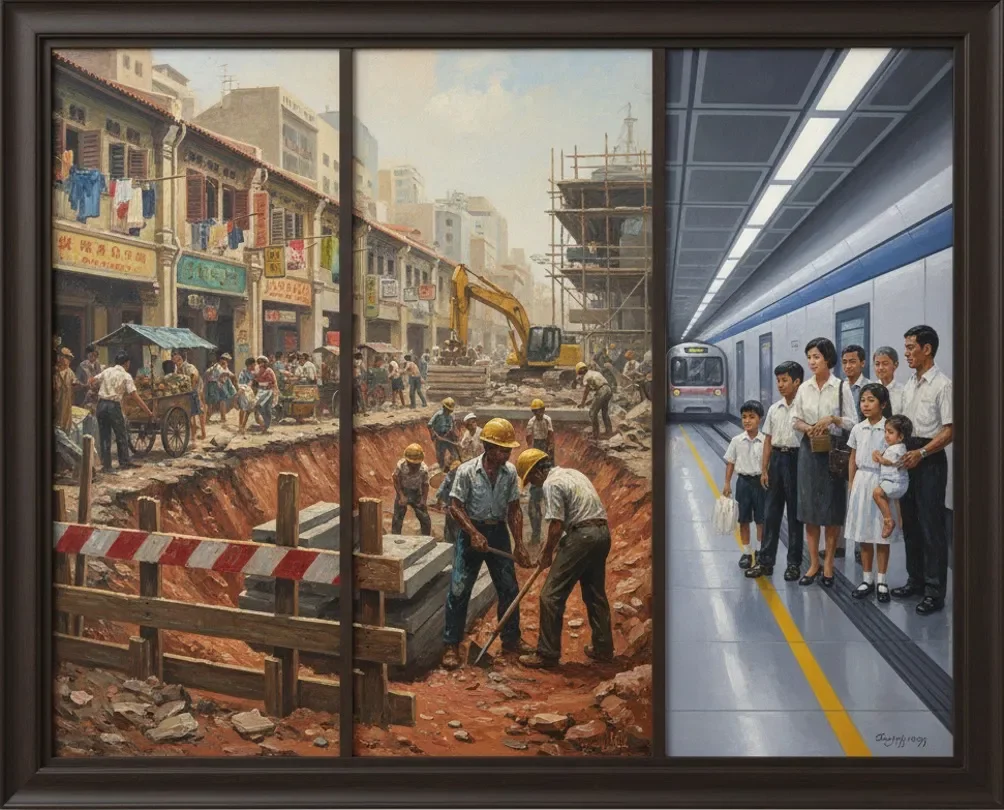
Koh Nguang How in collaboration with David Lee. EAS 70. Courtesy of the Artist
How should we think otherwise about lives that don’t neatly fit into the registers of the state archive? The Strange Archive might be understood as an exhibition that, drawing on what curator Dr. Adrian Tan calls a “parodic” curatorial logic, nurtures a productive relation to strange absences and with our own strangeness.
The Strange Archive is situated in an exhibition room on the fourth floor of Tanjong Pagar Distripark, a former warehouse converted for use as part of the Singapore Art Museum. The exhibition technically didn’t start anywhere, and the centrepiece was a series of cascading upwards tables in the centre of the room which divided it equally into halves. I began my viewing with a plaque placed on the lowest of the tables. The exhibition’s curatorial framing is articulated explicitly on the plaque, which reads:
In Singapore, where archives are often tethered/pegged/tied to state narratives or institutional frames of memory, an official archive is expected to behave predictably and to hold history still. This exhibition begins from a somewhat different position. It proposes that the archive is restless, shifting, and fundamentally strange. This strangeness is not a deviation to be corrected, but a method for learning how to see again, a way of destabilising what is known, making familiar histories feel uncanny, and opening new vocabularies for ground, identity and belonging.
That is, The Strange Archive seeks to situate the archive as less about historical closure and more about possibility otherwise. This orientation draws on the pedagogical quality typical of Singapore’s national museums without the linearity and fixity of them.
Rather than naming a counter-archive that mirrors official history in negative form, “the strange” in this archive operates as a methodological stance toward the archive itself. It draws attention to the oddity of how materials arrive, settle, and acquire authority, while refusing the promise of explanatory closure. Strangeness also stabilises the archive as an object of interpretation, allowing familiar histories to appear uncanny. What is unsettled includes how artefacts are connected, valued, and rendered legible.
The Strange Archive thus approaches the archive as a process shaped by power and not a neutral store of facts. As Ann Laura Stoler has argued, archives record not just events but the conditions under which certain forms of knowledge become legible while others remain obscured. The exhibition operationalises this insight materially. Gaps are neither repaired nor explained away. Instead, uncertainty is staged through display strategies—like cascading tables—that foreground fragmentation, speculation, and misalignment. Read this way, The Strange Archive demonstrates how strangeness can function as a curatorial method for engaging state-managed memory across Asia, working within institutional forms without resolving them into either heritage affirmation or oppositional critique.
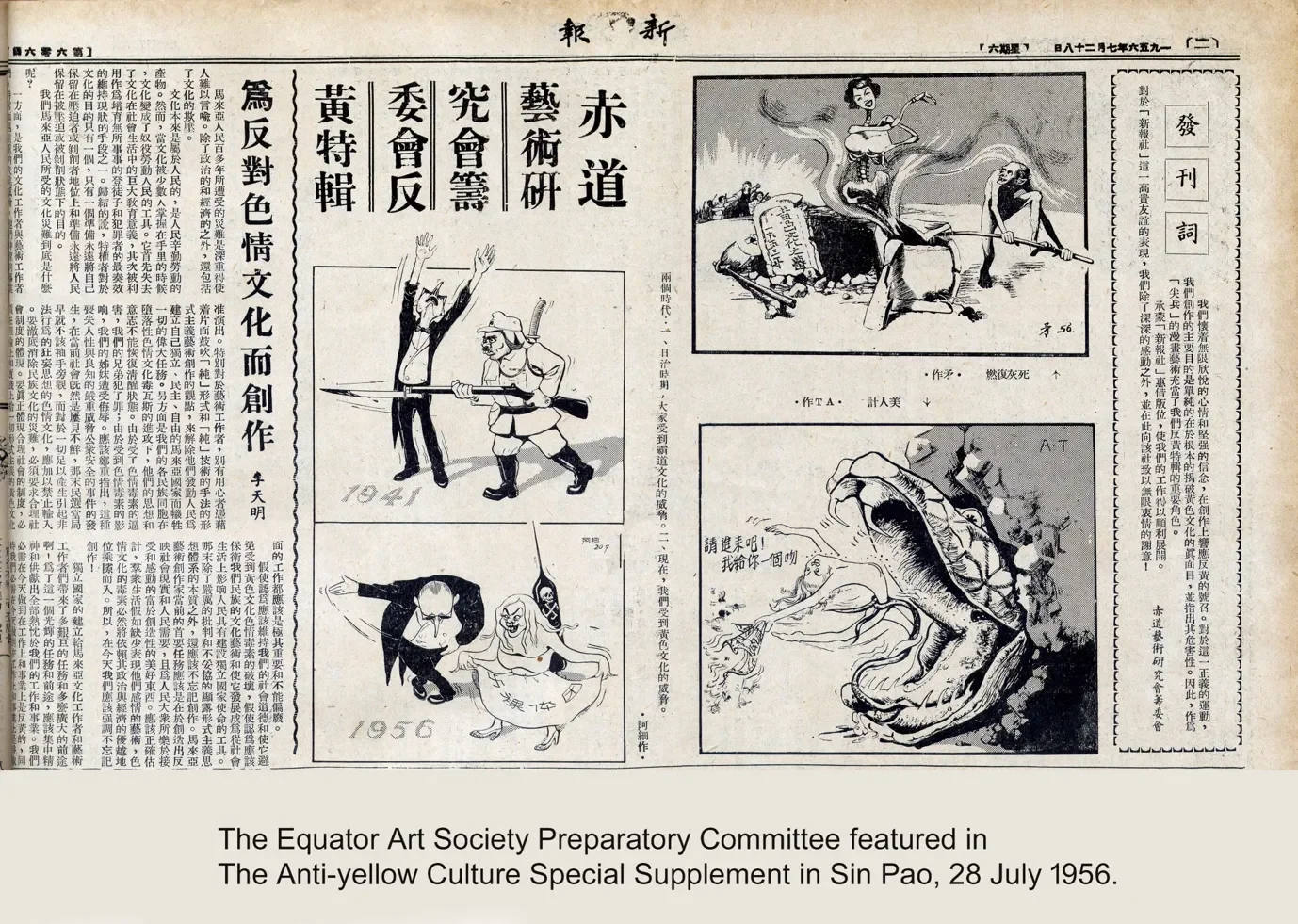
Koh Nguang How, Equator Art Society archival installation, n.d. Mixed archival materials. Courtesy of the artist.
Koh Nguang How is a Singaporean artist and archivist whose work interrogates the presence of arts institutions in Singapore, and particularly the story of Equator Art Society. Koh sets out his archival work, tracing a story of newspapers that show the proliferation of the Equator Art Society and their anti-colonial and social realist work throughout the 1950s and 1960s. The materials are densely arranged, requiring close, sustained reading rather than casual viewing. Newspaper clippings, photographs, and printed matter are layered tightly, producing a visual field that resists quick synthesis. Viewers are compelled to move laterally along the display, repeatedly adjusting distance in order to piece together partial narratives. This physical labour of reading mirrors the political difficulty of accessing the Society’s history, positioning archival research itself as an embodied, effortful act rather than a transparent recovery of facts. This gap between the group’s activity and disbandment remains shrouded in mystery, as Lim Cheng Tju (2005, p. 45) notes:
There is no record of a visual artist being detained under the ISA for political activities, although in the mid 1970s, theatre activists like Kuo Pao Kun were detained. The “real” story behind the closing of the Equator Art Society in 1972 remains a mystery.
Rather than treating uncertainty as a problem to be resolved, Koh’s practice activates ambiguity as a site of speculation. The absence of a definitive account does not signal archival failure, but exposes how political consciousness, institutional pressure, and aesthetic practice exceed what the archive can securely hold. By refusing correction or closure, Koh situates the Equator Art Society’s anti-colonial commitments in dialogue with contemporary struggles, allowing the past to remain unsettled rather than rendered legible through retrospective explanation. Such an approach resonates beyond Singapore, suggesting how artists and curators across Asia might engage state-saturated archives without producing either nationalist affirmation or oppositional counter-history.
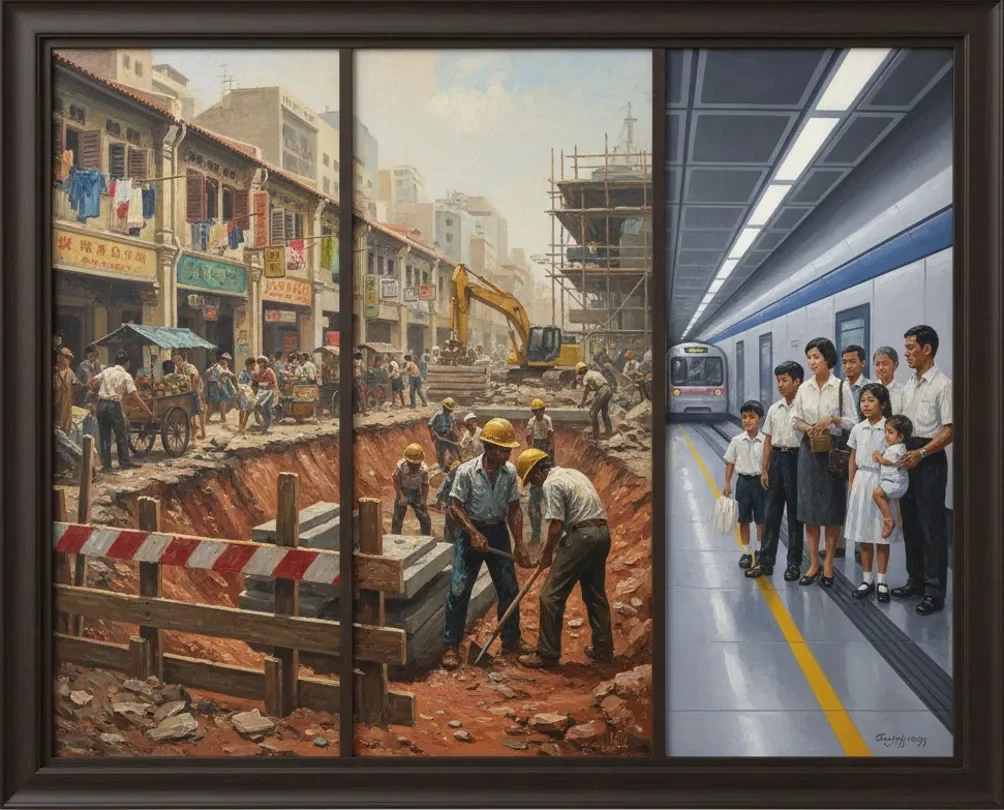
David Lee, EAS 70, 2026. Courtesy of the artists.
Collaborating with designer David Lee, Koh presents a “pseudo-commemorative show” for the Equator Art Society in EAS 70 (2026), speculating on the work the collective might have produced had they remained together. This collaboration is distinguished by its integration of AI, which blurs the boundaries between speculative history and reality. While these works offer compelling depictions of crises—such as COVID-19 and labour rights issues—anomalous details frequently emerge, appearing as if from another world. By mimicking the Equator Art Society’s aesthetic, the AI-generated images can be read to deal with contemporary crises. Yet it also introduces a sense of strangeness. This speculative commemoration risks severing political struggle from historical accountability, raising questions about whether AI-generated remembrance clarifies collective memory or aestheticises its unresolved violence.
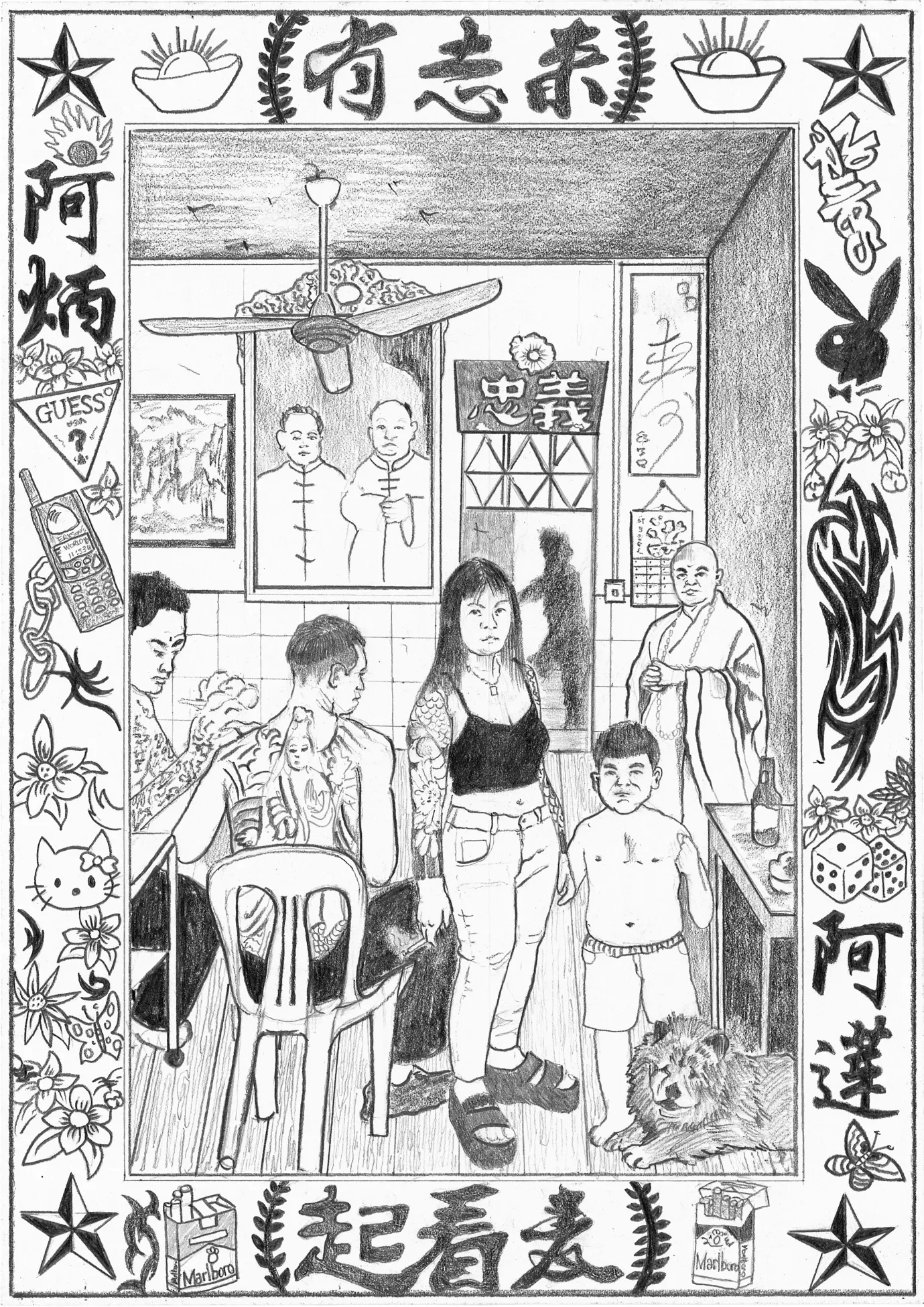
Ezekiel Wong, Wu Ji Lai, Qi Kua Mai, 2025. Graphite on paper. Courtesy of the artist.
Ezekiel Wong’s Wu Ji Lai, Qi Kua Mai (2025) offers a possibility of thinking about how we might attend to these disturbances. In this graphite on paper piece, Wong situates Ah Beng and Ah Lian in a manner that reworks the destabilising gaze associated with canonical portraiture, particularly Diego Velázquez’s Las Meninas (1656). Here, Wong refuses the viewer’s desire for easy recognition. The figures do not invite us in, but instead “look beyond what is often dismissed as vulgar or excessive, turning toward the quieter structures of care, kinship, and survival that persist at the edges of aspiration.”
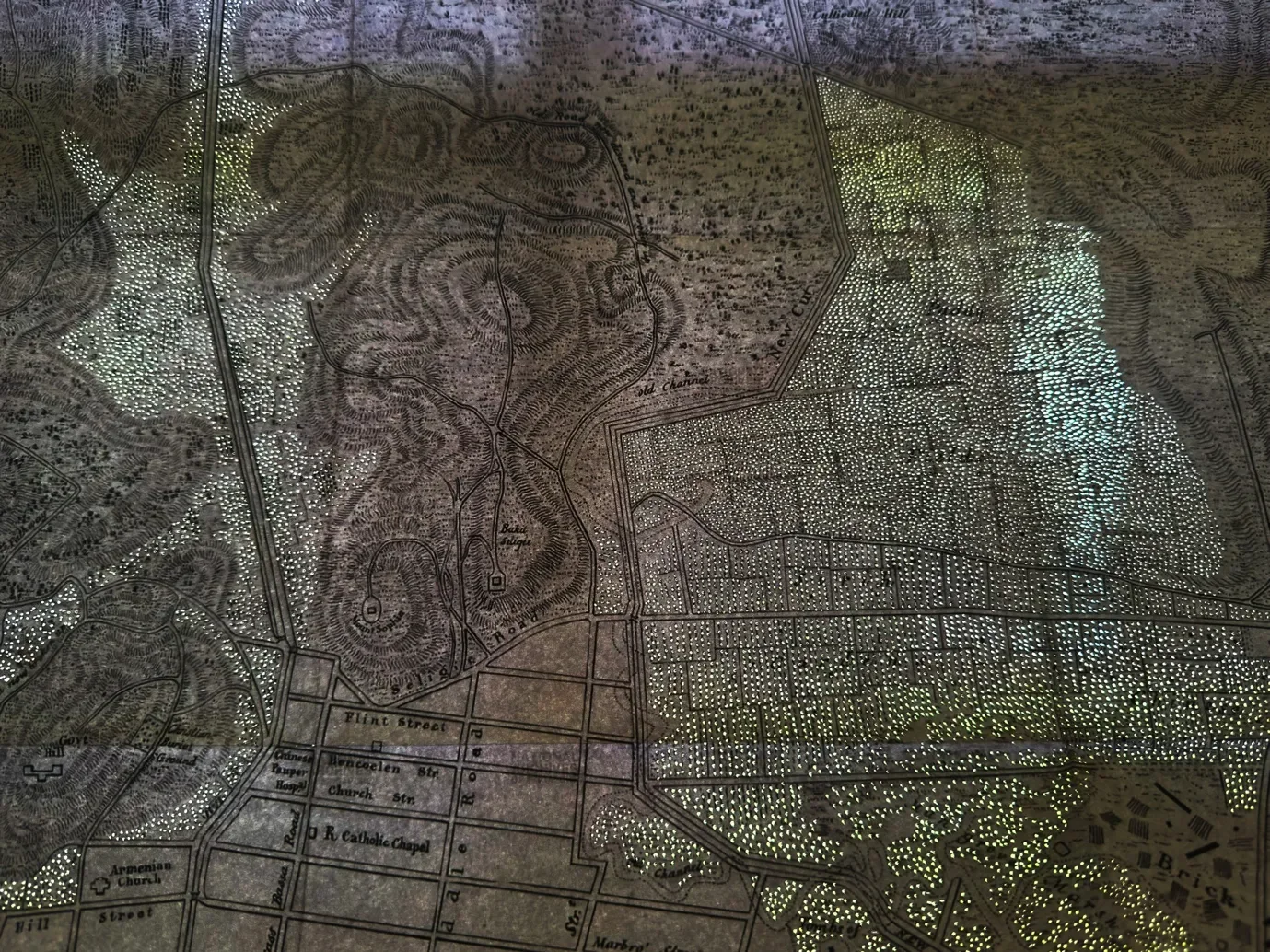
Superlative Futures (Wong Zi Hao), Fireflies and Constellations, 2026. Courtesy of the artist.
Superlative Futures (Wong Zi Hao) and Akai Chew mobilise strangeness to interrogate architecture, suggesting new ways of envisioning more caring urban design. In the diptych Fireflies and Constellations (2026), Superlative Futures pricks Jean-Baptiste Tassin’s 1836 Map of the Town and Environs of Singapore, to “reimagine the city centre’s dry, stable, and habitable ground as porous and unstable.” Similarly, Akai Chew’s Reclamation and Redemption (2026) shows a series of machine-generated coastal and landform images that draw directly on the visual language of reclamation planning. Read together, Wong’s and Chew’s works do not simply return us to an essentialist view of the land but treat the techniques that affix colonial formations to the soil as sites for speculation/
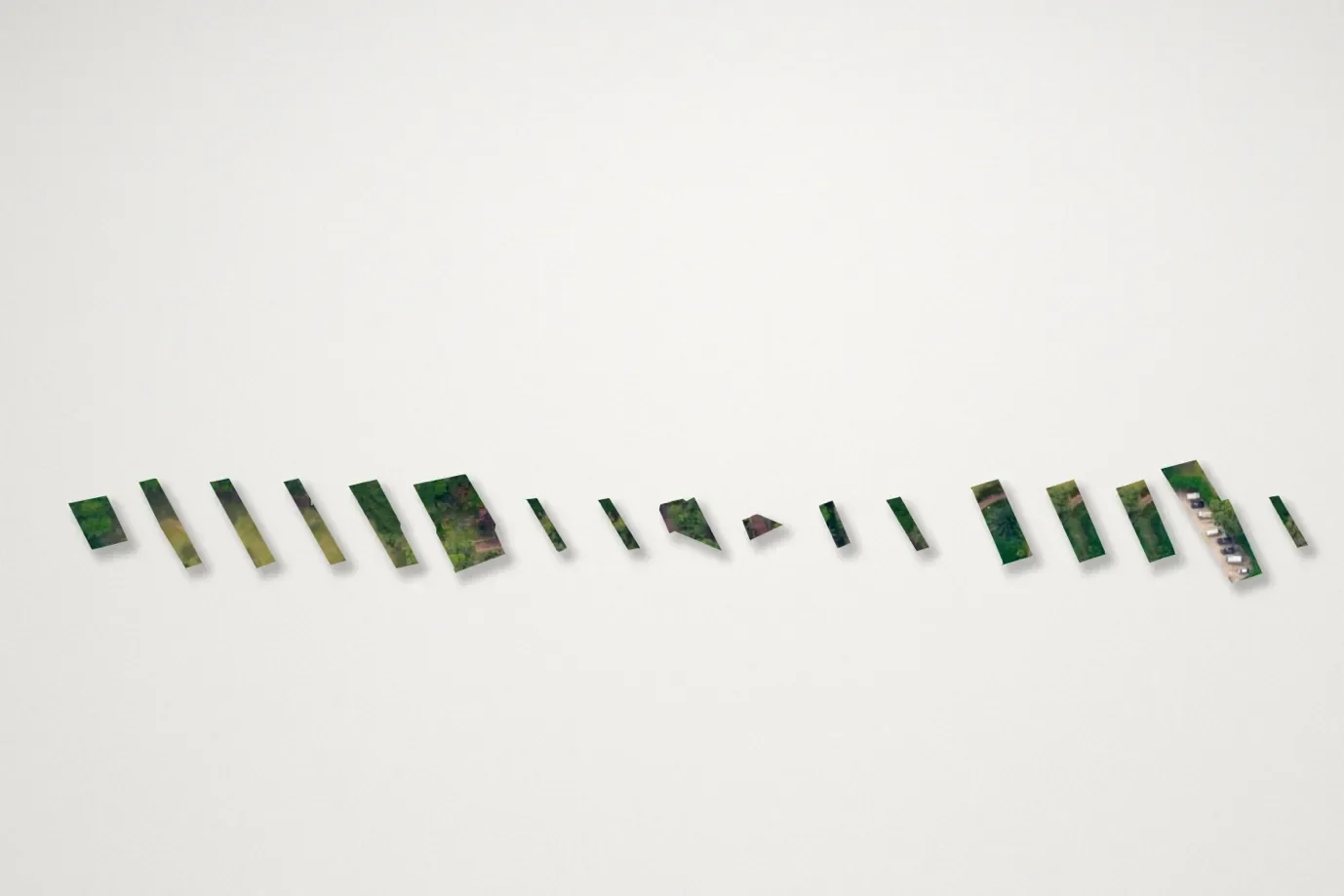
Akai Chew, North Bridge Garden, 2026. Courtesy of the artist.
Yet it is precisely this ongoing process of construction that becomes a site of tension. On the one hand, construction functions both as a means of contesting the landscape as an archive and as a way of relating to more-than-human life. In North Bridge Garden (2026), Chew fragments the landscape into its constituent forms as rendered through urban planning maps. Everyday buildings are stripped away, leaving only the administrative boundaries of land parcels—what the work frames as a “conceptual archive” that is “abstract, regulatory, and largely hidden from public view.” By reducing land to its plotted outlines, the work unsettles what makes space feel lived-in, drawing attention instead to the processes through which land is rendered legible, governable, and inhabited.
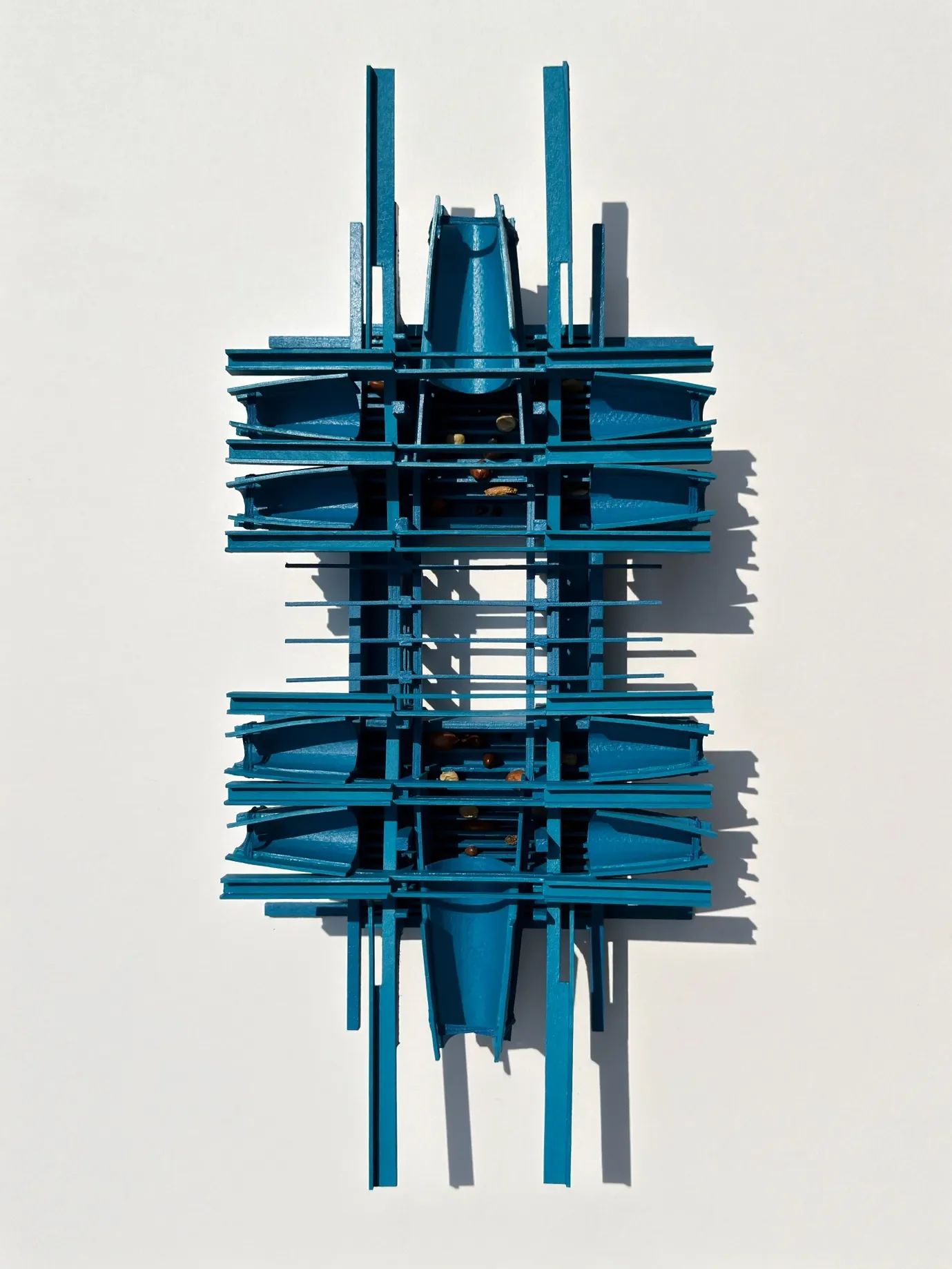
Ezekiel Wong, Seed Palace, 2025. Courtesy of the artist.
On the other hand, Wong approaches the question of the archive through accumulation rather than erasure. Rather than emptying space, Wong considers how archives are sustained through practices of care. Seed Palace (2025) invites viewers to consider how the built environment might be designed with non-human life in mind. Framing seed vaults as acts of care oriented toward an unknowable future, the work proposes that such infrastructures constitute a form of anticipatory archiving. In doing so, Seed Palace suggests that the techniques through which seed vaults preserve life might also be extended to other forms of urban architecture, offering alternative models for how cities might archive, sustain, and relate to more-than-human worlds.
Rather than positioning construction and care as antagonistic, Wong’s and Chew’s works suggest that both operate as techniques for rendering relations visible. By making the familiar terrains of reclamation and planning maps feel alien, Wong and Chew draw attention to the violence embedded in clean urban cartographies and archival regimes. These logics—which Chew deconstructs through geometric erasure and Wong reimagines through speculative practice—systematically exclude the ‘messy’ textures of community formation and everyday attachment. It is through such exclusions that certain identities become vulnerable to caricature. When the lived-in vitality of space is erased from the map, figures such as the Ah Beng or Ah Lian—whose belongings are often grounded in alternative socialities—are stripped of their cultural context and rendered strange in a more pejorative sense, appearing as undesirable aberrations within a landscape that would rather not have recorded their formal existence.
The exhibition’s politics lie not in recovering marginalised histories wholesale, but in modelling a curatorial practice that is attentive to how archives function as administrative technologies—an issue that shapes cultural production across much of contemporary Asia. Taken together, the works in The Strange Archive do not simply depict strangeness as an aesthetic quality, nor do they treat it as a lack to be remedied through fuller representation. Instead, strangeness unsettles how archives, landscapes, and figures are made intelligible. By holding open ambiguity, refusing explanatory closure, and reworking erasure and care, the exhibition renders the politics shaping what is recordable and what is disposable.